Floral in Abstract Print Style: Evaluating Design Versatility and Technical Formats
Selecting the right visual asset requires balancing aesthetic appeal with technical utility. When designers, crafters, and print-on-demand sellers evaluate floral motifs, they often encounter a specific category that bridges traditional botany and modern graphic design: Floral in Abstract Print Style. This design approach deconstructs natural flower forms into shapes, colors, and textures that suggest organic life without replicating it photographically. Understanding this style is essential for anyone comparing digital assets, as it offers distinct advantages in scalability and application versatility compared to realistic botanical illustrations or geometric patterns.
The decision to utilize an abstract floral design often hinges on project requirements regarding longevity, medium, and audience perception. Unlike literal representations that can appear dated as photographic trends shift, abstract florals tend to maintain relevance through color theory and composition rather than specific species accuracy. Furthermore, acquiring this design in multiple formats—specifically SVG, Transparent PNG, EPS, and DXF—provides a comprehensive toolkit for cross-platform production. Evaluating whether this multi-format package aligns with your workflow involves understanding the unique properties of abstract florals and how they compare to alternative design categories.
Defining the Aesthetic Distinction
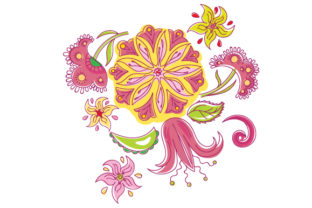
Floral in Abstract Print Style is characterized by interpretive representation. Where a botanical illustration prioritizes anatomical correctness and scientific detail, abstract florals prioritize mood, movement, and color interaction. The petals may be simplified into sweeping curves, the stems reduced to dynamic lines, and the color palette liberated from natural constraints. This distinction is critical when comparing options for branding or merchandise.
In practical terms, this style occupies a middle ground between rigid geometry and chaotic realism. It retains enough organic recognition to evoke nature but removes the specificity that might clash with diverse product lines. For example, a realistic rose design dictates a romantic or vintage context. An abstract floral interpretation of the same bloom could fit equally well on minimalist stationery, contemporary apparel, or industrial packaging. This ambiguity is a functional feature, not a flaw, allowing the design to adapt to various backgrounds and adjacent graphics without visual conflict.
Comparing Abstract Florals to Alternative Styles
When researching design resources, it is necessary to weigh abstract florals against other prevalent categories. Each style serves different strategic purposes, and recognizing these tradeoffs prevents mismatched expectations.
Abstract vs. Photorealistic Botanicals
Photorealistic florals excel in conveying luxury, tradition, and specific seasonal themes. However, they present significant technical limitations. Raster-based photographs lose quality when scaled up for large-format printing like banners or wall murals. They also carry heavy visual weight, making them difficult to layer over complex backgrounds. In contrast, Floral in Abstract Print Style is typically vector-native or designed with clean edges. This allows for infinite scaling without pixelation and easier integration into layered compositions. If your project requires resizing across vastly different dimensions—from business cards to duvet covers—the abstract option generally offers superior technical flexibility.
Abstract vs. Geometric Patterns
Geometric patterns provide structure and uniformity, making them ideal for backgrounds and textiles requiring seamless tiling. However, pure geometry can sometimes feel sterile or overly corporate. Abstract florals introduce organic asymmetry that humanizes a design while maintaining the repeatability of a pattern. For users deciding between a strict tessellation and a flowing motif, the abstract floral offers a compromise: it provides the visual rhythm of a pattern with the emotional warmth of nature. This makes it particularly effective for wellness brands, educational materials, or products targeting demographics that value both order and creativity.
Abstract vs. Hand-Drawn Line Art
Hand-drawn line art conveys authenticity and artisanal craftsmanship. Yet, single-weight line work can lack the visual impact needed for certain applications, such as sublimation printing or laser engraving where fill areas define the image. Abstract floral prints often incorporate solid shapes, gradients, or textured fills alongside line work. This added dimension ensures the design remains legible at small sizes and impactful at large ones. When evaluating resources for mixed-media projects, the filled abstract style often outperforms simple line art in terms of production versatility.
Evaluating Format Utility: SVG, PNG, EPS, and DXF
The value of a digital design asset is intrinsically linked to its file formats. Receiving Floral in Abstract Print Style in SVG, Transparent PNG, EPS, and DXF formats addresses four distinct production workflows. Understanding the specific utility of each helps determine if this bundle meets your technical needs or if you require specialized alternatives.
- SVG (Scalable Vector Graphics): This is the primary format for web use and consumer-grade cutting machines like Cricut or Silhouette. Because SVG code defines shapes mathematically, it remains crisp at any zoom level. For abstract florals, which rely on smooth curves and precise color separation, SVG is superior to raster formats for digital displays and vinyl applications. It also allows for easy color editing within browser-based tools or vector software.
- Transparent PNG: While vectors are ideal for editing, raster files remain necessary for compatibility. A high-resolution transparent PNG serves as a universal bridge for platforms that do not support vectors, such as certain print-on-demand interfaces, word processors, or social media tools. The transparency is crucial for abstract designs, allowing the organic shapes to overlay colored backgrounds seamlessly without white bounding boxes. Ensure the resolution is sufficient (typically 300 DPI) for print applications.
- EPS (Encapsulated PostScript): This format is the industry standard for professional print shops and advanced vector editing in Adobe Illustrator or CorelDRAW. EPS preserves complex path data and color profiles better than SVG for commercial offset printing. If you plan to send the abstract floral design to a professional screen printer or embosser, EPS is often the required deliverable. It acts as the master source file for high-fidelity reproduction.
- DXF (Drawing Exchange Format): Originally developed for CAD engineering, DXF has become essential for laser cutting and CNC routing. Unlike SVG, which may contain rendering artifacts incompatible with industrial machines, DXF translates curves into precise toolpaths. For makers using Glowforge, xTool, or similar laser systems to cut abstract floral shapes from wood or acrylic, DXF minimizes errors and reduces cleanup time. Its inclusion signals that the design is optimized for fabrication, not just visual display.
Decision Factors: Strengths and Tradeoffs
No design style is universally optimal. Choosing Floral in Abstract Print Style involves accepting specific tradeoffs in exchange for its benefits. A balanced evaluation requires acknowledging where this style excels and where it may fall short.
Strengths in Application
The primary strength lies in adaptability. Abstract florals are inherently trend-resistant because they are not tied to a specific decade’s interpretation of realism. They also offer superior color customization; changing the hue of an abstract shape is visually coherent, whereas recoloring a realistic photo often results in unnatural artifacts. Additionally, the multi-format availability reduces friction in hybrid workflows. A crafter can use the DXF for laser-cut wooden earrings and the PNG for matching packaging stickers, ensuring brand consistency across physical and digital touchpoints without redrawing the asset.
Limitations and Considerations
Conversely, abstraction sacrifices specificity. If a project requires identifying a particular flower for symbolic reasons—such as lilies for a memorial service or poppies for Remembrance Day—an abstract interpretation may be too vague to convey the intended message. Furthermore, abstract designs rely heavily on execution quality; poorly constructed vectors with jagged nodes or unbalanced compositions are more glaringly obvious in abstract art than in detailed illustrations where texture can hide imperfections. Buyers must scrutinize preview images for smooth curves and intentional negative space.
Another consideration is audience expectation. Older demographics or traditional markets may perceive abstract florals as incomplete or confusing compared to classic botanicals. Market research should validate whether the target audience appreciates interpretive art before committing to this style for commercial products.
Best-Fit Scenarios and Practical Examples
Determining when to select Floral in Abstract Print Style over alternatives depends on the intersection of medium, message, and production method. The following scenarios illustrate where this design category typically delivers the highest return on investment.
Apparel and Textile Design: Fashion trends cycle rapidly, but abstract florals allow for seasonal updates through colorways rather than complete redesigns. A single abstract floral master file can yield a spring pastel collection and an autumn jewel-tone line simply by adjusting fill colors in the SVG or EPS. This efficiency makes it ideal for small businesses managing limited inventory.
Laser Cutting and Fabrication: Intricate realistic flowers often result in fragile cuts with excessive burn marks due to dense detail. Abstract florals designed for DXF output typically feature optimized paths with appropriate kerf compensation and structural integrity. Makers producing wedding cake toppers, signage, or jewelry benefit from designs specifically simplified for machine readability.
Corporate and Institutional Branding: Organizations seeking to appear approachable yet professional often avoid clichéd clip-art roses. Abstract florals provide organic softness without sacrificing modern credibility. They work effectively in annual reports, presentation templates, and office environmental graphics where visual interest is needed without distracting from textual content.
Digital Content Creation: Bloggers, course creators, and social media managers need versatile assets that don’t dominate layouts. Transparent PNGs of abstract florals serve as excellent decorative elements in Canva templates or website headers. Their lack of photorealistic detail ensures text overlays remain readable, a common failure point when using busy photographic backgrounds.
Making the Final Selection
Ultimately, the choice to acquire Floral in Abstract Print Style should be driven by functional requirements rather than aesthetic preference alone. If your workflow spans multiple output methods—from digital screens to laser cutters—and you require a design that balances organic warmth with technical precision, this category offers significant advantages. The inclusion of SVG, Transparent PNG, EPS, and DXF formats future-proofs the asset against changing tools and platforms.
However, if your project demands botanical accuracy, targets a strictly traditional audience, or relies on photographic texture for emotional impact, exploring realistic illustrations or licensed photography may yield better results. Compare sample outputs, test file compatibility with your specific equipment, and assess whether the abstract interpretation aligns with your brand’s visual language. By evaluating these factors objectively, you ensure the selected resource supports both immediate production needs and long-term creative flexibility.