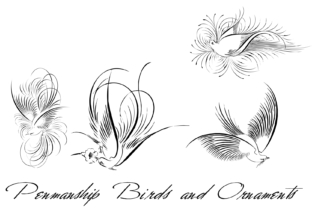
Penmanship Birds and Ornaments: Integrating Rough Avian Motifs into Modern Design
The intersection of natural illustration and typographic structure creates a unique visual language that transcends simple decoration. Within this niche, Penmanship Birds and Ornaments represent a specific aesthetic category where the fluidity of calligraphy meets the organic unpredictability of nature. Unlike polished vector graphics or photorealistic imagery, this style is defined by its roughness, gestural energy, and handcrafted imperfections. For designers, educators, and brand strategists, understanding the utility and application of these motifs is essential for creating work that feels authentic, tactile, and historically grounded while remaining relevant to contemporary audiences.
The Aesthetic Anatomy of Rough Penmanship
To effectively utilize Penmanship Birds and Ornaments, one must first understand what distinguishes them from standard clip art or formal engraving. The defining characteristic is the "rough" quality, which refers to the visible evidence of the writing instrument and the human hand. This style typically emerges from broad-nib pens, brushes, or textured quills where ink flow is inconsistent, and stroke edges are feathered rather than crisp.
This aesthetic serves a functional purpose beyond mere nostalgia. In an era dominated by sterile digital perfection, the irregularities in rough penmanship signal authenticity to the viewer. When a bird motif is rendered with varying line weight and ink splatter, it communicates movement and life. The floral ornaments accompanying these avian forms are rarely symmetrical; instead, they follow the rhythm of the pen stroke, creating a sense of spontaneous growth. This organic asymmetry makes Penmanship Birds and Ornaments particularly effective for projects requiring a personal touch or a connection to traditional craftsmanship.
Materiality and Digital Translation
Professionals working with these assets must consider the translation from physical medium to digital format. Original Penmanship Birds and Ornaments were often created on textured paper with absorbent fibers, contributing to the bleeding edges that define the style. When digitizing or selecting pre-made assets, preserving this texture is critical. Over-smoothing or auto-tracing can strip away the very characteristics that give the style its value. High-fidelity scans that retain paper grain and ink variation are superior to clean vectors for this specific genre, as they maintain the tactile illusion necessary for the rough penmanship effect.
Strategic Applications Across Industries
The versatility of avian and floral penmanship allows these elements to function across diverse sectors. However, their implementation varies significantly depending on the user's objective and audience expectations.
Branding and Packaging Identity
For business owners and brand designers, Penmanship Birds and Ornaments act as powerful signifiers of heritage and artisanal quality. They are frequently employed in industries where provenance matters:
- Specialty Foods and Beverages: Wine labels, craft spirits, and gourmet food packaging use these motifs to suggest small-batch production and natural ingredients.
- Sustainable Fashion: Clothing tags and hangtags featuring rough bird illustrations reinforce commitments to eco-friendly materials and slow fashion.
- Boutique Hospitality: Stationery suites for bed and breakfasts or eco-resorts utilize floral and avian borders to establish a sense of place and tranquility.
In these contexts, the ornamentation does not merely decorate; it validates the premium positioning of the product. The roughness implies that human hands were involved in the creation process, justifying a higher price point and fostering emotional connection.
Educational and Therapeutic Contexts
Educators and researchers in art therapy or early childhood development find unique value in the imperfect nature of Penmanship Birds and Ornaments. Unlike rigid coloring book lines, rough penmanship models demonstrate that beauty exists in variation. For students learning fine motor skills or calligraphy, studying these forms provides a more forgiving entry point than formal copperplate scripts. The emphasis is on gesture and observation rather than geometric precision. Furthermore, the natural subjects—birds and flowers—provide a neutral, universally appealing focal point that can reduce anxiety and encourage mindfulness during creative exercises.
Editorial and Publication Design
Book designers and publishers utilize these ornaments as functional navigation tools. In literary fiction, poetry collections, and nature journals, Penmanship Birds and Ornaments serve as chapter headers, section breaks, and margin notes. Their visual weight helps break up dense text blocks without introducing the heaviness of solid graphics. Because the style is inherently directional (following the flow of handwriting), these ornaments can subtly guide the reader’s eye across the page, improving readability and pacing. The choice of specific bird species can also add a layer of semantic meaning, reinforcing thematic elements of the text through visual symbolism.
Technical Considerations for Implementation
Successfully integrating Penmanship Birds and Ornaments requires attention to technical details that preserve the integrity of the style. Creators must navigate challenges related to scaling, color, and composition.
Scaling and Resolution Management
The rough edges that define this style are resolution-dependent. If scaled too large, pixelation can turn intentional texture into unintentional artifacting. Conversely, if scaled too small, the delicate ink bleeds may fill in, turning a detailed bird into an unrecognizable blob. Designers should always work with high-resolution source files (minimum 600 DPI for print) and test outputs at actual size before finalizing layouts. For web applications, SVG formats with preserved filter effects or high-quality WebP images are preferable to standard JPEGs to maintain edge definition without excessive file bloat.
Color Theory and Ink Interaction
Historically, Penmanship Birds and Ornaments were monochromatic, relying on ink density for contrast. Modern applications often introduce color, but this must be done carefully to avoid negating the penmanship aesthetic. Flat, saturated digital colors can clash with the organic texture of rough strokes. Instead, professionals should employ watercolor washes, muted earth tones, or duotone treatments that mimic traditional media. When using multiple colors, ensuring that the ink layer interacts naturally with the color layer—through blending modes like Multiply or Overlay—maintains the illusion that the piece was created physically.
Compositional Balance and Negative Space
Rough penmanship carries significant visual texture, which means it competes for attention. When pairing Penmanship Birds and Ornaments with typography, ample negative space is mandatory. Crowding these detailed illustrations against busy backgrounds or ornate typefaces creates visual noise. The best results occur when the ornaments are allowed to breathe, serving as anchors of complexity amidst simpler elements. Designers should treat the white space around the bird and floral motifs as an active part of the composition, not merely empty background.
Sourcing, Licensing, and Ethical Usage
As demand for authentic hand-drawn aesthetics grows, so does the market for Penmanship Birds and Ornaments. Professionals must approach sourcing with diligence to ensure quality and legal compliance.
Distinguishing Authentic Work from AI Generation
The current landscape includes both genuine hand-drawn assets and AI-generated approximations. While AI can mimic the general appearance of rough penmanship, it often fails to replicate the logical stroke order and anatomical accuracy of birds and plants. Researchers and discerning creators can identify authentic work by looking for consistent nib angles, natural ink pooling at stroke terminals, and botanically accurate vein structures. For projects where authenticity is a core brand value, verifying the human origin of the artwork is increasingly important for maintaining consumer trust.
Licensing Nuances for Commercial Use
Many Penmanship Birds and Ornaments originate from public domain sources, such as 19th-century copybooks and naturalist field guides. While these are free to use, modified versions or curated collections may carry new copyrights. Business owners must verify whether a specific asset is truly public domain or if it is a proprietary restoration. Additionally, licensing terms for modern hand-lettered assets vary widely; some permit unlimited commercial reproduction, while others restrict usage to personal projects or require attribution. Maintaining clear records of asset provenance protects organizations from potential intellectual property disputes.
The Psychological Impact of Organic Line Work
Beyond aesthetics and technique, the enduring appeal of Penmanship Birds and Ornaments lies in their psychological resonance. Neuroaesthetics research suggests that humans have an innate preference for fractal patterns and organic curves found in nature. Hand-drawn representations of birds and flowers trigger biophilic responses, reducing stress and increasing engagement. In user interface design and environmental graphics, incorporating these elements can soften institutional environments and make digital spaces feel more welcoming.
Furthermore, the "rough" quality activates mirror neurons associated with motor empathy. Viewers unconsciously simulate the hand movements required to create the image, creating a kinesthetic connection between creator and observer. This embodied cognition explains why Penmanship Birds and Ornaments often feel more intimate and memorable than their polished counterparts. For communicators seeking to build rapport and convey sincerity, this neurological advantage is a tangible asset.
Future Trajectories in Hand-Lettered Illustration
The trajectory of Penmanship Birds and Ornaments points toward hybridization. We are seeing increased experimentation where traditional rough penmanship is combined with modern layout grids, kinetic typography, and augmented reality. Rather than being relegated to vintage revival, these motifs are being recontextualized as counterpoints to technological saturation. As virtual and augmented environments become more prevalent, the grounding presence of imperfect, hand-rendered nature will likely increase in value.
For professionals across disciplines, mastering the use of Penmanship Birds and Ornaments is not about replicating the past. It is about leveraging a timeless visual vocabulary to solve contemporary communication challenges. Whether enhancing the perceived value of a product, facilitating educational outcomes, or simply bringing warmth to a digital interface, these rough avian and floral motifs offer a depth of expression that pure geometry cannot achieve. Understanding their nuances ensures that their application remains respectful of the tradition while pushing the boundaries of modern design.